Home Server Architecture
I self-host a private cloud to manage my smart home, back up media, collaborate on documents, and run local AI models. This setup focuses on enterprise-grade reliability using workstation hardware, a Zero Trust network architecture, and a roadmap towards a robust 3-2-1 backup strategy.
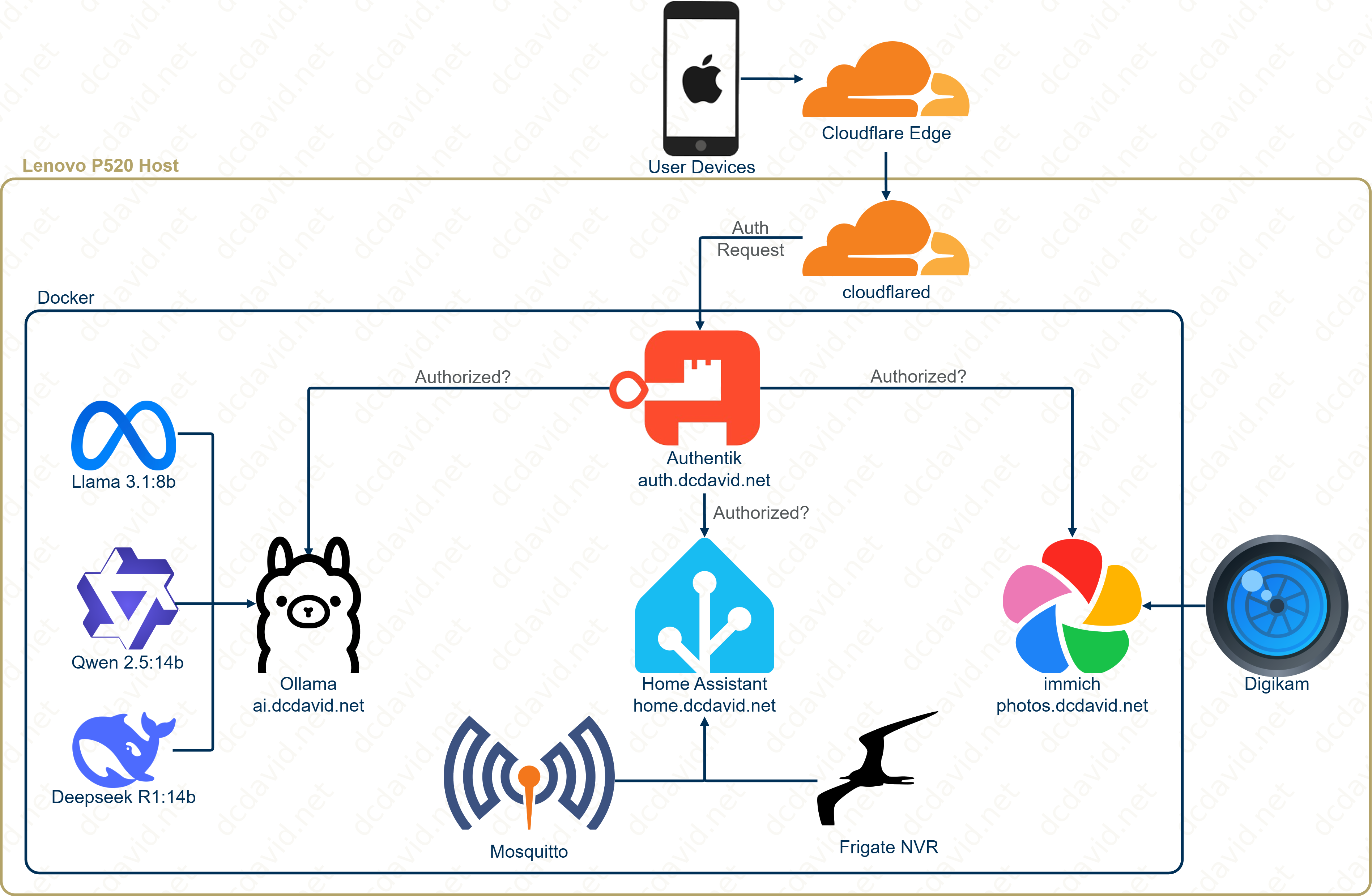
1. Hardware Stack
My server is built on a refurbished Lenovo ThinkStation P520. I chose this platform for its reliability (ECC memory), expandability (PCIe lanes), and silent operation.
| Component | Specification | Purpose |
|---|---|---|
| Host | Lenovo ThinkStation P520 | Enterprise Workstation Base |
| PSU | Lenovo 54Y8979 | 900W certified for 92% energy efficiency (80 PLUS Platinum) |
| CPU | Intel Xeon W-2150B | 10 Cores / 20 Threads (Skylake-W) |
| RAM | 128GB DDR4 ECC 2133MHz | Quad-Channel stability for ZFS/Database caching |
| GPU 1 | NVIDIA RTX 3060 12GB | NVENC Transcoding, Frigate NVR, Local LLM Inference, & Secondary Gaming Card (for two players) Refurbished with Gelid GP-Extreme and Thermal Grizzly Kryonaut |
| GPU 2 | NVIDIA RTX 3060 12GB | Additional VRAM for AI Workloads & Primary Gaming Card Refurbished with Gelid GP-Extreme and Thermal Grizzly Kryonaut Connected with ADT-Link 16x Riser for PCIE Relocation Mounted with 1" Diameter Sorbothane Bumpers |
| Storage | 2TB NVMe (Gen3x4) 1TB Samsung 870 QVO | Fast boot and application datasets |
| Cooling | Noctua NH-D9DX i4 3U (CPU) 2x NF-A12 (Front), 1x NF-A8 (Flex Bay) 1x NF-A9 (Rear), 2x NF-A4 (PCIe) | Positive pressure airflow and silent operation |
| Fan Control | Aqua Computer Quadro | Setting fan curves to optimize for noise and eliminate specific hotspots, with onboard memory to remove software dependency |
| Networking | Intel AX210 Wi-Fi 6E | Backup connectivity & Bluetooth |
| Accessories | 4K EDID HDMI Plug Magnetic PVC Mesh Antminer Fan Simulator | Headless operation Air filter Eliminate high-noise fans |
2. Network & Security Architecture
I utilize a Zero Trust ingress strategy. There are no open ports on my physical router. All traffic enters via an encrypted Cloudflare Tunnel, passes through Authentik for identity verification, and is then proxied to the internal Docker network.
Security Strategy: "Defense in Depth"
For Home Assistant, I employ a split-security model to accommodate mobile clients without compromising safety:
- Browser Access: Protected by Authentik. I must authenticate via SSO (with 2FA) before the request ever reaches Home Assistant.
- API Access: The
^/api/.*path bypasses Authentik to allow the Home Assistant Companion App to sync background data (battery, location). Security is delegated to Home Assistant's Native Auth, which rejects any request lacking a valid Long-Lived Access Token. - Zero-Trust: "Trusted Networks" bypass is disabled. Even requests passing through the internal proxy are treated as untrusted until valid credentials are provided.
Identity Management (LDAP)
I have transitioned from disparate local accounts to a centralized LDAP architecture.
- Source of Truth: Authentik serves as the LDAP Provider.
- User Sync: Services like Nextcloud sync user accounts and groups directly from Authentik via an LDAP Outpost.
- Role-Based Access Control (RBAC):
nc_admin: A dedicated "Break Glass" service account for system maintenance.dcdavid: A standard user account with no administrative privileges, used for daily operations to adhere to the Principle of Least Privilege.
VPN & High-Bandwidth Ingress (Tailscale)
While web services utilize Cloudflare, latency-sensitive and high-bandwidth applications (like remote game streaming) require a direct, peer-to-peer connection.
- Direct Tunneling: A single UDP port (41641) is forwarded at the router edge to bypass DERP cloud relays, unlocking the bandwidth required for flawless 60 FPS ultrawide streaming while maintaining cryptographic WireGuard security.
- Zero-Trust ACLs: The Tailscale network is strictly segmented. Cloud-level Access Control Lists (ACLs) ensure authenticated VPN clients can only reach specific streaming and administrative ports, preventing lateral network movement.
- Host Firewall Enforcement: The Windows Defender firewall is explicitly configured to drop all incoming traffic on streaming ports unless it verifiably originates from the Tailscale network adapter.
3. Implemented Services
All services run as Docker containers managed via docker-compose.
Local AI Stack
A completely private, offline Artificial Intelligence platform running on dual RTX 3060s for 24GB of combined VRAM.
- Backend: Ollama running in Docker with NVIDIA Container Toolkit (GPU Passthrough). The container leverages tensor parallelism to split model layers across both GPUs.
- Frontend: Open WebUI (ChatGPT-style interface) accessible at
ai.dcdavid.net. - Capabilities:
- Web Search: Integrated DuckDuckGo for real-time fact-checking.
- Code Interpreter: Sandbox environment for executing Python/Data Analysis tasks.
- Voice Chat: Web API integration with Kokoro.js (
fp16) for natural, real-time Text-to-Speech (TTS) and Speech-to-Text (STT) capabilities.
- Model Roster (30B Tier):
- Daily Driver Pro (Gemma 3 27B): General purpose chat, brainstorming, and writing assistance.
- Live Agent (GLM-4.7 Flash): Ultra-fast sparse MoE architecture designed specifically for low-latency voice conversations and rapid tool calling.
- Data Engineer (Qwen 2.5 Coder 32B): Specialized syntax engine for complex SQL, Python, and Docker infrastructure generation.
- Cognitive Logic (DeepSeek R1 32B): Deep reasoning engine utilizing Chain-of-Thought processing for architectural planning and logic formulation.
- Math & Algo (Nemotron 3 Nano 30B): Dedicated engine for mathematical proofs and quantitative algorithm evaluation.
Cloud Gaming & Remote Desktop
A high-performance, low-latency streaming stack designed for headless operation and multi-tenant gaming.
- Streaming Engine (Apollo & Moonlight): Provides a "virtual hardwire" experience, capturing and encoding the desktop via NVENC for locked 60 FPS streaming at ultrawide resolutions (2560x1080) with imperceptible latency.
- Multi-Seat Architecture (DuoStream): Modifies the host OS to support multiple independent Windows profiles simultaneously. This splits the workstation's resources, dedicating one RTX 3060 to my personal AI/gaming workloads and the second RTX 3060 to a completely isolated, concurrent gaming environment for my girlfriend's laptop.
- Headless Display Management (SudoVDA): Generates hardware-accelerated virtual displays that natively match the connecting client's unique resolution and DPI scaling. This eliminates the need for physical HDMI dummy plugs and completely bypasses locked 16:9 aspect ratios.
Nextcloud Hub
A complete productivity suite replacing Google Drive and Microsoft Office.
- Modules:
- Files: Secure cloud storage for documents and projects.
- Office: Integrated Collabora Online for real-time editing of Word, Excel, and PowerPoint documents directly in the browser.
- Notes & Collectives: Markdown-based journaling and wiki documentation.
- Security Hardening:
- HSTS Enforced: Strict Transport Security is applied both at the Cloudflare Edge and the application level (via custom Apache headers).
- Transactional Email: Integrated via Resend (SMTP) for reliable password resets and notifications.
- Background Jobs: Offloaded to system cron (via sidecar container) to prevent UI lag during maintenance tasks.
Home Assistant
Integrates disparate IOT ecosystems into a single dashboard.
- Auth Strategy: Double Login (Authentik Proxy + Native Login).
- Dashboard: Custom dashboard using Mushroom Cards, Advanced Camera Card (Frigate), and Card-Mod for CSS overrides.
- Key Integrations:
- Blueair: Reliable local control for the 211i Max purifier.
- Dreame Vacuum: Map & mode control via the Dreame Vacuum (Beta) integration.
- SmartRent: Bridges my apartment's lights, thermostat, and door locks into HA.
- Cync (GE): Local control for kitchen LED strips.
- Tuya: Official cloud integration for Eightree smart plugs.
- Frigate: Local NVR integration for object detection, recording, and rich notifications.
- Rich Notifications: highly-detailed notifications are sent to family devices via Home Assistant, with deep-linking to specific event clips.
Frigate NVR
Local Network Video Recorder replacing cloud subscriptions.
- Architecture: Runs alongside Mosquitto (MQTT Broker) to provide real-time sensor data to Home Assistant.
- Streams: Dual-stream configuration (SD @ 5fps for AI Detection, 2K HD @ 15fps for Recording).
- Storage: Continuous 24/7 recording retained on dedicated SSD storage.
- Live Provider: go2rtc bundled service for instant low-latency streaming to dashboards.
Immich
A self-hosted photo and video backup solution replacing Google Photos.
- Hardware Acceleration: Uses the RTX 3060 (NVENC) for machine learning (face recognition) and video transcoding.
- Auth: OIDC (OpenID Connect) via Authentik. Native database login is disabled.
- Storage: Data is bound to physical SSDs (Drive D:), separate from the boot NVMe.
Authentik
Unified Identity Provider (IdP) & LDAP Source.
- Handles Single Sign-On (SSO) for all services via OIDC and Proxy.
- Acts as an LDAP Provider, allowing legacy or complex apps (like Nextcloud) to sync users and groups dynamically.
- Enforces Multi-Factor Authentication (MFA) for all services.
- Acts as a forward-auth proxy for services that lack built-in robust authentication.
4. Automated Content Pipeline
To ensure professional documentation standards, I maintain a custom CI/CD pipeline for this repository that treats assets as code.
- Algorithmic Asset Generation: I utilize a custom Python engine (
generate_assets.py) to render academic figures. This ensures all visualizations (from ML4T financial charts to KBAI benchmarks) adhere to a strict design system (Georgia Tech color palette) and are automatically watermarked to prevent plagiarism. - Asset Optimization: Build scripts like
one_time_compress_jpgs.pyandoptimize_pngs.pyrun against the asset directory to perform lossless compression and strip metadata. This keeps the deployment lightweight without compromising visual fidelity. - Git Hygiene: The repository enforces strict separation of code and state. Secrets, databases, and sensitive variables are strictly excluded (via
.gitignore) and managed via environment variables.
5. Roadmap & Active Development
I am currently developing the following subsystems to reach full operational capability (FOC).
Security Hardening
- Headless Service Architecture: Transitioning Docker Desktop to run as a native Windows Service. This will decouple application uptime from user sessions, allowing for stricter physical access controls (locking the console) without interrupting background services.
Bird Identification System
- Objective: Automated species recognition and public livestreaming.
- Classification: WhosAtMyFeeder (Docker Container).
- Subscribes to Frigate via MQTT.
- Processes "Bird" object snapshots against a specialized species model.
- Returns species confidence scores to Home Assistant for "New Species" notifications.
- Public Stream: Embed go2rtc WebRTC streams directly into the personal website.
- Ingest: RTSP feeds from PoE cameras.
- Expose: Dedicated Cloudflare Tunnel hostname (e.g.,
stream.dcdavid.net) bypassing Authentik for public read-only access. - Embed: Low-latency
iframeintegration into MkDocs.
Disaster Recovery (3-2-1 Strategy)
- Objective: Eliminate single points of failure for critical data (Configs, Databases, Photos).
- Hot Sync (Failover): Establish real-time, unidirectional sync to a secondary Lenovo P520 using Syncthing.
- Cold Storage (Offsite): Implement scheduled, encrypted delta-syncs to AWS S3 Deep Glacier using
rclone.
Storage & Media Expansion
- File Server: General purpose NAS storage for documents and installers.
- Media Server: Dedicated service for long-form media (Movies/TV), separate from personal photo backups.
- DigiKam Workflow: Implement a pipeline to generate and write standard EXIF data to legacy childhood photos and videos, ensuring they appear correctly in the Immich timeline.
6. Build Notes & Technical Gotchas
Remote Hard Reboots
To ensure high availability, the BIOS is configured for AC Power Recovery: Power On. This allows me to hard-reboot the server remotely by simply toggling my smart plug off and on if the OS ever completely freezes.